
Universal Truths
Unspoken costs

There are universal truths in the Midwest.
The “tap to pay” debit card function never works the first time at Casey’s. Midwesterners refuse to follow traffic rules at two-way or four-way stops. And some agricultural practices are killing my neighbors, but we don’t talk about it.
I spoke in Cedar Rapids on Saturday night. It was the Linn County Democrats Hall of Fame to honor four local Democrats who dedicated themselves to local and national politics for decades.
Each one of them deserved the award and more.
I have a mission as of late — to speak in a way to wake up the audience. To fire them up. There is no time to waste. Not one second.
I tried to deliver a barn burner. I hope they left with fire in their soul. A spark to spread in their community and to their neighbors.
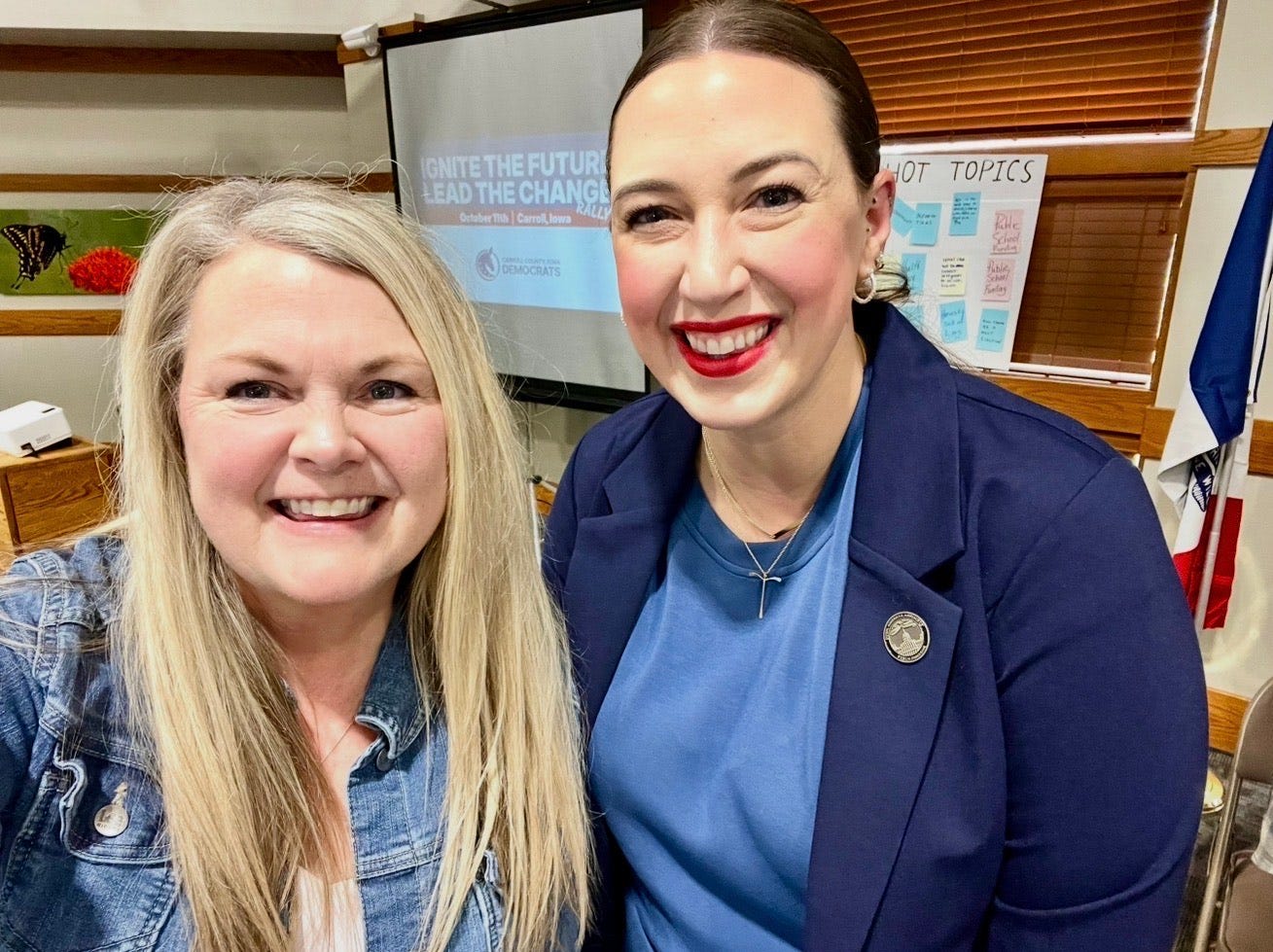
A rural Iowa event with State Senator Catelin Drey, who recently broke the Iowa Republican supermajority with her special election win. 10/11/25.
On my way up to Cedar Rapids, I was waved through a four-way stop. And then another. It’s very sweet, but it would be very confusing for anyone who isn’t from this part of the country.
On the drive, I caught myself staring at the red and orange trees showing off right now. I guess I was looking out the window too much because my car told me to keep my eyes on the road…I turned that feature off.
I like looking out the window, and no car is going to tell me what to do.
But the trees. And the farmhouses. And the little towns. And the views that stretch for miles.
And field after field after field.
And yet it’s the fields that are killing Iowans. Everyone in Iowa knows someone with cancer. Many of the people in my Iowa audiences are survivors. Everyone has lost someone, and agriculture is causing the deaths.
It’s also taboo to talk about the reason for all of these deaths — farm practices and farm policies. Fertilizers. Corporate Ag.
Government policies reward and compensate too much corn that needs too much fertilizer which runs off into too many streams and rivers and eventually kills too many people.
There is so much going on each day and it’s hard to focus on any one thing. How can I focus on the ag policies of the state three miles up the road when ICE is terrorizing people and kids could go hungry soon and Trump dismantles democracy?
When I read or think too long on the situation of this country, I have to remind myself to unclench my jaw and relax my muscles.
I once watched a documentary on Teddy Roosevelt, and the narrator spoke about Roosevelt’s habit of constantly clenching his fists out of “nervous energy.” Maybe that’s what I can start calling my anxiety — nervous energy.
But back to Iowa.
I know a man from Iowa City who owns a publishing company. He publishes Iowa authors. He recently sent me a book he thought I would like. I didn’t hold out much hope because reading has been getting difficult recently. I mean, I read all day long, but it is usually snippets and short pieces. Long form is more challenging lately. My anxiety is through the roof.
Teddy Roosevelt’s nervous fist comes to mind.
I gave the book a try. Not only did I like it, but I immediately realized that I was reading a man who writes in the same plain-spoken style that I write. Some of the sentences were so familiar that I knew I was reading a kindred spirit. Another rural advocate. A fellow traveler.
I felt seen.
But this author is much better at his craft. Infinitely better.
His name is Art Cullen, and he won a Pulitzer Prize for his writing. His book is titled Dear Marty, We Crapped in Our Nest, and I was smitten from the first page. From the first rural Iowa sentence I consumed.
You know those books that you have to put down in your lap and look away to ponder the truth you just read?
It’s that kind of book.
He talks about rural Iowa and politics and ag and how we got into this mess. He talks about the booming cancer rates. He uses his community, Storm Lake, to walk us through everything from corn to school vouchers to immigration to climate change.
“In summer, a green blanket of plant life covers the gently rolling hills of Iowa. From the air, the trillions of plants in fly-over land might look like a picture of nature’s bounty. Looks can be deceiving.”
Cullen also writes about rural rage. He writes competently and truthfully about that rage and how it creates voting blocs that Republicans have come to count on.
But unlike other books on that topic, I don’t feel compelled to tear this book to pieces. I hate White Rural Rage because the authors know nothing of the rural spaces they stereotype. They have nothing on Art Cullen.
Cullen’s book is a breath of fresh, rural air. I respect his positions because he speaks on what he knows. He is rural and speaks rural.
“Everything got bigger. Farms. Machinery. Trucks. Livestock herds. Houses on the lake for doctors and ag financiers. Everything but the rural working person’s bank account. Profits that used to be held by more diverse family farms flowed to bigger corporate operations backed by real capital. The rest of us became hired help.”
Cullen speaks on farming and the environment:
“The ag supply chain is woven around government crops and predicated on petrochemicals to sustain them. Farmers, for the most part, must participate or perish.”
Cullen also tells us of the population that leaves Iowa each year:
“Fewer than half of Iowa’s public university graduates remain in the state. We call it brain drain. That doesn’t say much for those of us who didn’t leave. You begin to feel stupid. Deplorable.”
I felt that.
I am not an extremely emotional person. I don’t cry often. I cried at the end of the book. Not for any particular reason other than relief.
Art Cullen managed to see what I see every day. He captured the goodness of the people he knows. The people I know.
He tells a hard story, but one with hope. There is still hope in Iowa. In the Heartland. Things can change, and the state is at a tipping point.
Art Cullen sees the soul of the Midwest. The heart of America told through the lens of a man who lives it.
This book is full of Midwestern universal truths…even if he never mentions Casey’s.
It is rare for me to be so taken with a non-fiction book. But this is a rare book.
A gem mined from the Iowa cornfields.
~Jess
I’m gonna buy this book. Order it through my local independent book store, Toadstool. I’m from New Hampshire ( and can also think of 5 folks I know here who are Iowans). Anyway, Jess, from one former English teacher to another.. you bring the light .. and the heat 🔥.. thank you 🙏
I grew up in very rural Nebraska in the 1950s. We sort of envied Iowa because it seemed so much richer for farming, 'the real Midwest', whereas we were Great Plains, which was windier, dryer, much more difficult for farming. (Also, Iowa had girss' basketball, which was inthinkable in NE.) Gradually the single windmills on farms morphed into the creeping circles of irrigation, sucking up water from the Ogallalla Aquifer. Other changes were happening. My mom, who had been the first grandchild on either side of her family, was killed in a a car wreck in 1973. Many of her cousins came to the funeral, all from "Cather Country', Red Cloud, Bladen, Guide Rock etc. Someone asked my second cousin Ron what, in his opinion, had been the biggest change in rural Nebraska in his lifetime. "The loss of the family farm." -- That was a big shock to me. I'd lived away from the area for quite a while. I wasn't sure what he was talking about, really. I can certainly see that now.