
I'm Not Crying

I’m not one to show much emotion in public. I mean, I show a lot of love and enthusiasm, but when it comes to sadness, or god forbid, crying, I am not participating.
I was raised with a strict “no crying” policy, and I have not been able to shake my stoic inheritance, no matter the occasion.
The problem is the embarrassment I feel at crying in public. I definitely don’t think it makes me any better than anyone who cries in public…it may make me worse. Makes me look cold, when I am really soft and mushy inside.
A bleeding heart liberal who can’t bleed in public.
I just can’t muster the courage to cry in front of folks…but there have been a few notable exceptions in my life, and many of them came when I was teaching.
I taught American Literature for years, and one of my favorite units of study was the Civil Rights Era. We are all familiar with the movement for civil rights in our country. We are also too familiar with the violence perpetrated onto Black Americans during the time.
One of the poems I taught during my Civil Rights unit was The Ballad of Birmingham written by Dudley Randall. The poem was written in the aftermath of the bombing of the 16th Street Baptist Church in Birmingham, Alabama in which a Klan member placed dynamite in the church and killed four little girls. A truly horrific crime that Martin Luther King, Jr described as, “one of the most vicious and tragic crimes ever perpetrated against humanity.”
“Mother dear, may I go downtown
Instead of out to play,
And march the streets of Birmingham
In a Freedom March today?”
“No, baby, no, you may not go,
For the dogs are fierce and wild,
And clubs and hoses, guns and jails
Aren’t good for a little child.”
“But, mother, I won’t be alone.
Other children will go with me,
And march the streets of Birmingham
To make our country free.”
“No, baby, no, you may not go,
For I fear those guns will fire.
But you may go to church instead
And sing in the children’s choir.”
She has combed and brushed her night-dark hair,
And bathed rose petal sweet,
And drawn white gloves on her small brown hands,
And white shoes on her feet.
The mother smiled to know her child
Was in the sacred place,
But that smile was the last smile
To come upon her face.
For when she heard the explosion,
Her eyes grew wet and wild.
She raced through the streets of Birmingham
Calling for her child.
She clawed through bits of glass and brick,
Then lifted out a shoe.
“O, here’s the shoe my baby wore,
But, baby, where are you?”
I taught the poem every year, and every year I called on a student to read it after I presented the premise of the poem. I could not read it aloud and keep my composure — my eyes welled up during the reading, and I always walked to the back of the class in case my eyes started to leak despite my best attempts to keep them dry.
I think the mother in me can’t imagine the prospect of losing a child and I could not fathom the pain the mother feels when she finds her child’s shoe in the bits of glass and brick and she knows her baby is gone. Especially when the mother knew the dangers of a deeply racist country, and only relented to her child knowing she would be in a sacred place. In a church.
But she wasn’t safe.
She was murdered because she lived in a hateful, racist country. And this was the part that always hurts the most — I know that we still have those fears to contend with. The Civil Rights era is still upon us. We made a little too much progress, and we are being pulled back…kicking and screaming. Back into the past. Back into the fear and pain. Back into racism and all of the terrible isms.
Make America Great Again harkens all of the ugly. It encompasses the past. It enshrines the hate.
Makes me want to rage. Makes me want to cry.
I had that overwhelming feeling this Tuesday in a moment that should have felt like a celebration. I wanted to cry instead.
I was lucky enough to be involved in a documentary a few years back. It was called “Dirt Road Democrat” and it was shot and compiled by videographer Catherine Hoffman, who worked with Kansas City PBS.
The short film turned out so well that Catherine was nominated for an Emmy. She didn’t win, but the film was widely seen…even by the folks who compiled artifacts for President Obama.
My picture and a quote about rural schools are inside the Obama museum. It’s pretty unbelievable to tell you the truth. The archivists reached out to me over two years ago, and I remained completely silent on the topic because I thought that there was no way I was actually going to be included in the museum, and I didn’t want to embarrass myself.
Turns out — I am in it.
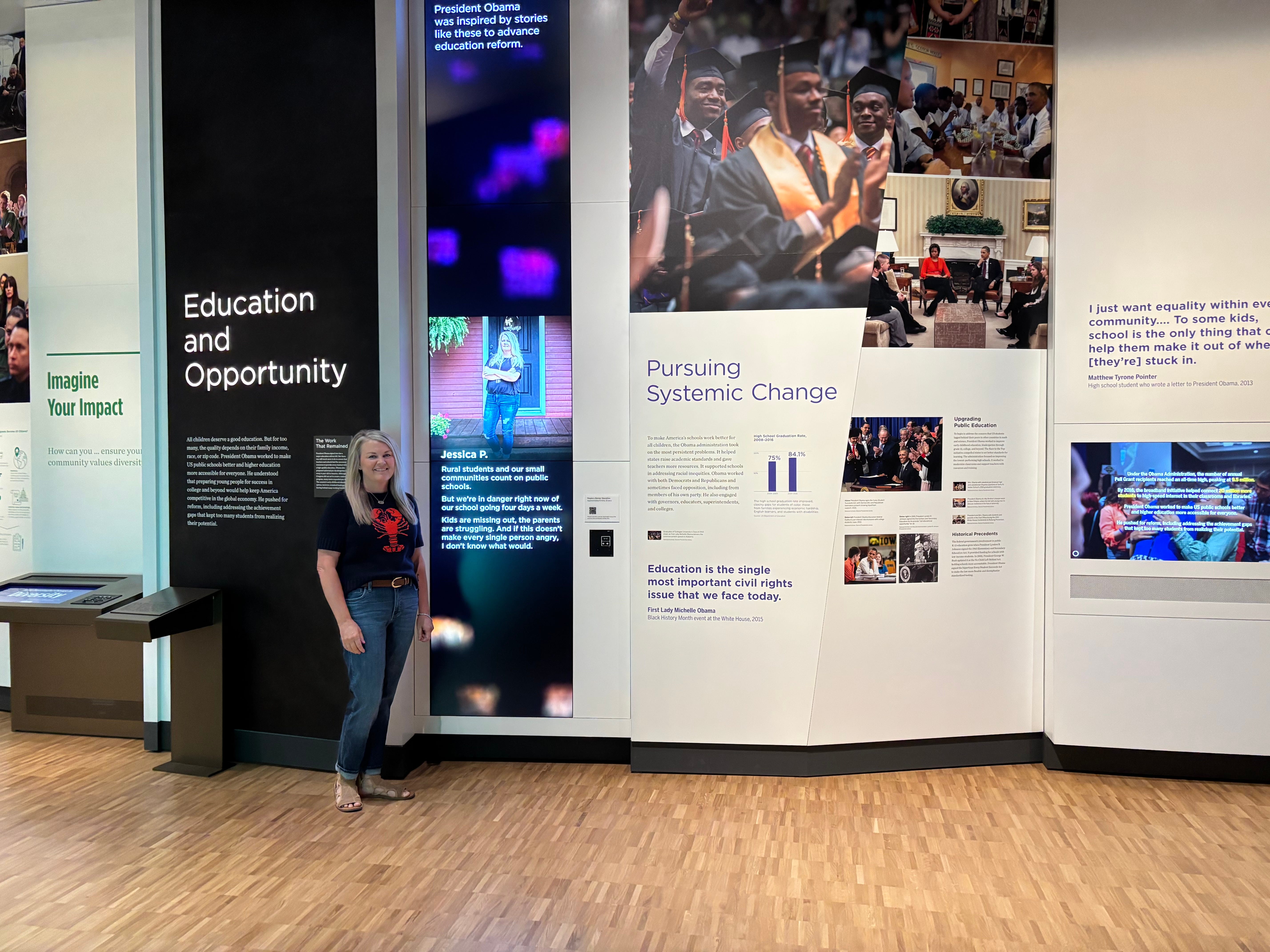
The Everyday People Exhibit, The Obama Presidential Museum. 6/2/26.
Reader, you should know, I was never obsessed with Obama. I thought he was a fine man and a good President, but I sleepwalked through his Presidency by working two jobs and raising two kids and finishing my BA and MA. I was busy and didn’t think too hard on DC politics.
It was only after he was gone that I understood the horrors to come. It was then that I reflected on his Presidency, but especially his words. His actions. His presence. His decency.
That’s what hit me in the museum. His voice is everywhere, and he isn’t spewing hate. His image is projected throughout the museum with his words over the images. His speeches are shown on walls and his quotes are painted everywhere.
I felt the tears well up, and I got very uncomfortable. I was incredibly touched by the vocabulary and literacy and decency. Something I haven’t heard in years.
And that’s when it hit me — we are living in hell. We have been living in hell. We are in Dante’s Hell. I feel like I’m in the first circle, even though I did no harm and committed no sin, but I am punished in a purgatory that won’t end.
It feels like an eternity of living without hope. An eternity of separation from others and yearning. An ache for what was. A desire for normalcy and civility.
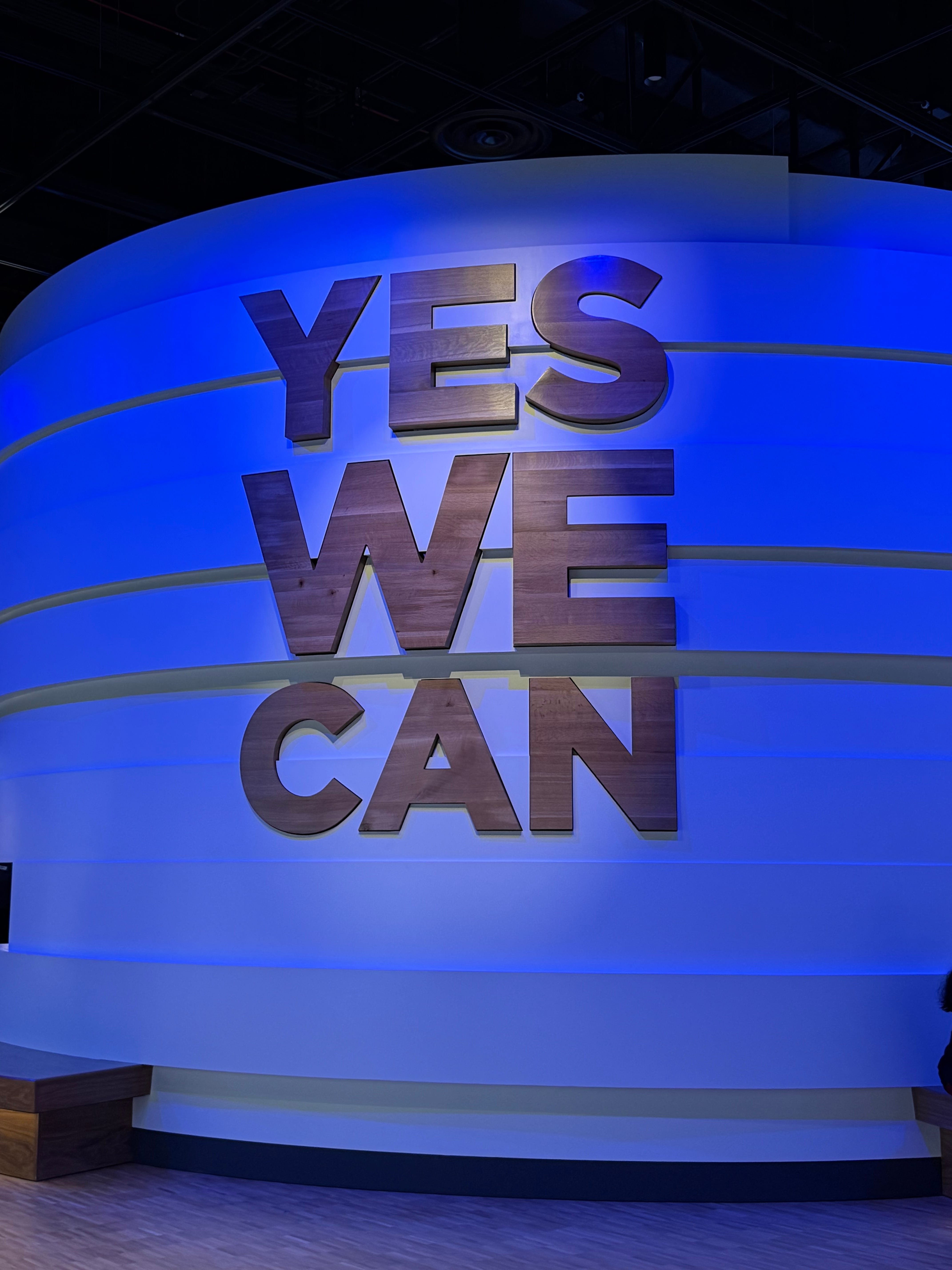
A large ‘Yes We Can” installation in the Museum.
I managed to keep my emotions in check for the entirety of my visit and I was so happy to be included in something so big that I had no business being included in.
The funny part is, after reflecting on our current hell and our current civil rights fights, I couldn’t help but think about our future. The future we all share. The future referenced over and over and over again in the museum.
Obama was not a perfect man — I don’t know any perfect people. He did seem to be laser-focused on making things better. Looking forward. Thinking positively. Trying to find something good in most folks.
And that’s what I took away from my short visit to Chicago. Hope. I haven’t felt it in my bones like that since…well, since 2016. I lost something that November, and I bet you did too.
We all lost something that we have been searching for since.
I didn’t cry at the museum for the same reason I don’t cry anywhere — I am too exhausted for the activity. I am too tired to let the tears fall. I am too busy to waste time drying my eyes.
I’m embarrassed that I am too worn out to cry.
I will continue to feel the grief and the anger and the weight of what this country has done and continues to do, but I will also carry the naive hope that I took away from the museum, if for nothing else but stubbornness.
Hope. I can feel it.
Hope. Yes, we can.
~Jess
You deserve to be in the Obama museum! Congratulations!
You are going to have us all crying, Jess.